
Gaslighting in a marriage is a serious form of emotional abuse where one partner manipulates the other into questioning their own memory, feelings, and reality. Over time, this kind of psychological control can quietly destroy a person’s confidence and sense of self.
Recognizing the warning signs early can make a huge difference in protecting your mental health and wellbeing. A licensed mental health expert shares the most common red flags to watch for.
1. Flat Denial of Events You Clearly Remember

Ever walk away from a conversation feeling like you imagined the whole thing? Flat denial is one of the most disorienting gaslighting tactics a spouse can use.
Your partner insists something “never happened” or “I never said that,” even when you remember it clearly.
Over time, repeated denials make you start doubting your own mind. Keeping a journal of events and conversations can help you hold onto your reality when someone keeps trying to erase it.
2. Being Told You Are “Too Sensitive”

Hearing “you’re overreacting” or “you’re so dramatic” after sharing a genuine concern is a classic gaslighting move. Your feelings are real and valid, and a healthy partner will acknowledge them, not mock or minimize them.
When someone constantly frames your emotions as a personal flaw, it slowly erodes your confidence. You may begin filtering your own reactions before expressing them, which is exactly what a gaslighter wants.
Trust your emotional responses. They exist for a reason.
3. Rewriting Shared History to Favor Them

Memory is not perfect, but there is a big difference between honest forgetfulness and deliberate rewriting. A gaslighting spouse will confidently retell shared events in a version that conveniently makes them look good and you look wrong or unstable.
Psychologists call this “narrative hijacking.” It chips away at your trust in your own recollections. If you notice your partner always seems to remember things in ways that favor only them, that pattern is worth paying close attention to.
4. Blame-Shifting That Leaves You Apologizing

You came to talk about something that hurt you, and somehow you ended up saying sorry. Blame-shifting is a hallmark of gaslighting, where your partner turns every conflict around so you become the guilty party.
In some cases, they even accuse you of the very behavior they are guilty of. Mental health experts call this “DARVO” – deny, attack, and reverse victim and offender.
Recognizing this pattern is the first step toward refusing to accept blame that was never yours.
5. Withholding Engagement or Refusing to Discuss Issues

“I’m not doing this again” is a sentence that shuts down communication rather than solving anything. When a spouse repeatedly refuses to engage with concerns or pretends not to understand what you are talking about, it is a form of control disguised as avoidance.
Withholding engagement isolates you emotionally and makes you feel your concerns are worthless. Healthy relationships require open dialogue.
A partner who consistently refuses to participate in honest conversation is blocking your ability to address real problems together.
6. Discrediting You to Friends and Family
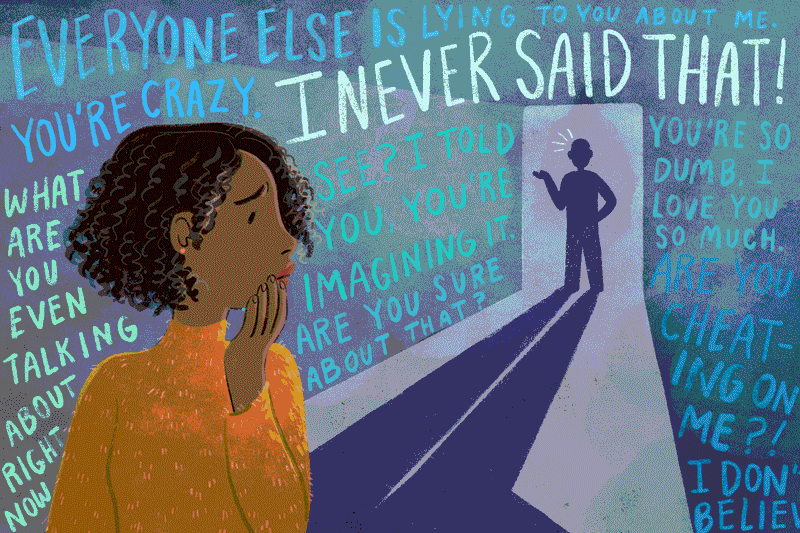
Gaslighting does not always stay behind closed doors. Some spouses extend their manipulation into your social circle by telling friends or family that you are “unstable,” “crazy,” or “impossible to reason with.”
This tactic serves a calculated purpose: it isolates you from your support network and makes people less likely to believe you if you ever speak up. If you notice your partner frequently painting a negative picture of you to others, pay attention to who benefits from that narrative.
7. Feigned Confusion to Make You Give Up

Repeated phrases like “I have no idea what you’re talking about” or “I don’t know where you got that idea” can wear a person down fast. This tactic, known as feigned confusion, is designed to frustrate you into dropping a topic entirely.
It works because most people eventually stop pushing when they feel unheard. Gaslighters count on your exhaustion.
If your partner frequently claims total ignorance about things you have discussed before, that consistent pattern is a warning sign worth taking seriously.
8. Using Your Insecurities as Weapons

Sharing your fears and insecurities with a partner is an act of trust. A gaslighter weaponizes that trust, pulling out personal vulnerabilities at strategic moments to destabilize or silence you.
Maybe you once confided about feeling inadequate at work, and now that detail gets thrown at you during arguments to make you feel small. Mental health experts describe this as one of the most painful forms of gaslighting because it turns intimacy into a tool of harm.
Guard your peace fiercely.
9. Intermittent Warmth That Keeps You Off Balance

One day they are cold and critical; the next, they shower you with affection and kindness. This unpredictable push-pull cycle is called intermittent reinforcement, and it is incredibly effective at keeping a person emotionally hooked.
The occasional warmth gives you hope that things will get better, making it harder to acknowledge the harmful pattern. Experts note this is similar to the psychology behind gambling – the unpredictable reward keeps you coming back.
Consistent love should not feel like a lottery you are trying to win.
10. Directly Questioning Your Sanity or Mind

“You’re imagining things.” “You’re losing it.” “Maybe you need help.” Words like these, said repeatedly by someone who is supposed to love you, can cause serious psychological damage over time.
Directly attacking your mental credibility is a calculated move to make you stop trusting yourself. Licensed therapists report that clients who have experienced this often spend years rebuilding confidence in their own perceptions.
You deserve a partner who supports your mental clarity, not one who deliberately undermines it.
11. Dismissing Your Needs as Unreasonable

Every person in a relationship has needs, and those needs deserve to be treated with respect. A gaslighting partner, however, often frames your requests as excessive, needy, or completely irrational, even when they are perfectly reasonable.
Over time, you may start to shrink your own needs before even expressing them, pre-apologizing for having them at all. That internal silencing is a sign that manipulation has taken root.
A loving partner may not always meet every need, but they will never mock you for having one.
12. Refusing Accountability and Denying They Hurt You

Accountability is the backbone of a healthy relationship. When a partner refuses to acknowledge that their actions caused harm and instead deflects or blames external factors, something is deeply wrong.
Gaslighters rarely offer genuine apologies. If they do say sorry, it often sounds like “I’m sorry you feel that way,” which places responsibility on your reaction rather than their behavior.
Mental health experts flag this non-apology pattern as a major red flag.
Real accountability sounds like “I was wrong, and I am sorry.”
13. Insisting They Are Not Lying Even With Proof

Catching your partner in a clear lie and still being told you are wrong is a deeply unsettling experience. A gaslighter will double down on their version of events even when you have screenshots, receipts, or witnesses to prove otherwise.
The goal is not to convince you of the truth. The goal is to make you question your ability to interpret reality at all.
Experts recommend documenting incidents carefully.
When someone denies undeniable evidence repeatedly, the problem is not your perception.
14. Inability to Disagree Without Attacking You

Healthy couples disagree. What sets gaslighting apart is what happens when you dare to hold a different opinion.
Rather than engaging respectfully, a gaslighting spouse labels you as “crazy,” “unstable,” or a “liar” the moment you push back.
This turns normal disagreement into an attack on your character and credibility. Many people learn to stop sharing their real opinions just to avoid the fallout.
Living in that kind of emotional silence is exhausting and isolating. You have every right to hold your own perspective without being attacked for it.
15. Persuading You Out of Your Own Reality

Some gaslighters are not aggressive. They are calm, articulate, and incredibly persuasive, which makes them harder to identify.
Through patient and repeated reframing, they gradually talk you into believing their version of events over your own lived experience.
You walk away from conversations genuinely unsure of what you know to be true. Therapists describe this as one of the most insidious forms of gaslighting because the manipulation feels reasonable in the moment.
Talking with a trusted friend or therapist can help you regain your footing.
16. Turning You Against People and Things You Love

Isolating a partner from their support system is a calculated part of many gaslighting relationships. A gaslighting spouse may make constant negative comments about your family, friends, or hobbies until you start seeing them through a negative lens too.
Gradually, you pull away from the people who might otherwise help you recognize what is happening. Mental health experts note that isolation is both a warning sign and a tool of control.
Maintaining your outside connections is one of the most protective things you can do for yourself.
17. Making You Feel You Constantly Have to Prove Yourself

Do you find yourself replaying conversations over and over, searching for proof that your concerns were valid? Gaslighting creates a relentless need for self-justification that follows you even when your partner is not in the room.
You may obsessively recheck texts, rehearse arguments, or question whether problems you experienced were real. This mental exhaustion is not a personality flaw.
It is a direct result of sustained psychological manipulation. Recognizing that the problem is not your perception is often the first real step toward healing.